Showing posts with label public health. Show all posts

Friday, December 30, 2011

Still raving about Better Access


From: //blog.artdoxa.com


This blog post is actually a very long comment on the blog by Jacinta Patterson titled "Argument by anecdote in mental health". The anecdote that Better Access money was being wasted on the over-concerned rich and not on the disadvantaged and genuinely mentally ill, seemed to be the main reason put forward in the press, explaining the cuts to Australia's mental health budget for 2011- 2013.

Aha- this post (referred to above) is still getting responses! I dropped in when it was first posted, but my comment doesn't seem to have got through! As a Better Access client and a former mental health researcher trained in public health, I can find many ways of examining the whole scheme!

It's difficult, firstly, to examine Better Access without the stats from the rest of the outpatient mental health sector. As someone said above, many people, mainly with schizophrenia or manic depressive disorder [these names make it clearer as far as I'm concerned; I know the controversy], are covered by Headspace and  community mental health clinics [which are hospital outreach disguised]. The NEW cases of psychoses, or those at high risk [pro-dromal; the people who were to receive medications if they seemed on the edge of real psychosis], hopefully benefited from Better Access, but I can't see how I can tease them out of the figures from the govt. I would assume that plenty of these people would not recognise they needed help, just as always happened in the past- the only way I imagine they got into Better Access would be if their GP was alert enough when seeing them for another complaint. How alert are GPs usually? Don't know- no figures. There's no epidemiological data from the past on this and I don't know anyone collecting it, so we can't judge.
Anguish at work- needs help

The figures suggest many new clients for mental health care under Better Access and the sudden proliferation of various therapist groups in the community suggests the same- there are community nurse mental health counsellors, psychology-trained, social-work-trained, [I don't know any] occupational therapy-trained plus more, putting up shingles. Most have few empty slots in their calendars, so someone is filling them. My guess is that new clients who couldn't afford private care before are cashing in on the Medicare scheme to get help they've needed for a long time. I know hardly anyone besides myself who has seen a psychiatrist for more than one session under Better Access and I think that is because psychiatrists won't take merely the Medicare rebate as full payment. Mine agreed to it beforehand, because I asked specifically and because I knew her before she qualified. However, her receptionist didn't know this and when I had received 2 sessions and handed her the rebate cheque for the first one she asked: "How would you like to pay the rest; cheque or credit card?". I told her I had no income, no insurance and no benefits, so she was going to have to accept Medicare or take me to court! My shrink cleared it up with her!
USA, ER visits for mental illness increased

I would suggest that psychiatrists have kept on seeing the same sort of clients they always saw- those referred through hospitals and other professionals, mainly privately insured [the uninsured wait to see their psychiatrist in hospital outpatient clinics every week and get the same doctors as they had privately], a slight leaning towards upper income, definitely more city/suburban people and hardly a trace of indigenous Aussies. However, at outpatient clinics there have continued to be stacks of lower-income clients, young people avoiding parental scrutiny and indigenous and other-cultural-group clients. Because there are virtually no psychiatric emergency "drop-in" centres, the poor old Emergency departments of public hospitals have copped the majority of psychotic, alcoholic and suicidal people, usually in terrible emotional states and which the emergency doctors, nurses, police and ambulance personnel are least trained to handle. Better Access could do with setting up a few Psych Emergency Facilities at least on the outskirts of  major towns. I don't think the community is going to suddenly get better at detecting mentally ill relatives and friends before they reach crisis point- they've never seen psychosis etc before, it's scary and they hope it will go away if they ignore it. Maybe the NEW Headspace places can change the culture of stigma and disdain of help-seeking by young men, but I'd like to see it happen before I'd have much hope.
In bed crying? Get help via Better Access

I'm a bit confused about why the change from 10 to 18 sessions in Better Access had to be made and announced because the clients from last year are going to have to see SOMEONE sooner or later. If clients who are still in need of care go back to their previous therapist, which most of us would prefer to do [and that would be therapeutically beneficial], are they suddenly going to say "Bugger off or pay me twice as much?" I can't see it happening except where psychiatrists have hard-hearted receptionists! I'd like to hear from some people about their experiences, since there's NEVER going to be a statistic on this!

As for GPs getting less money for the first consultation under Better Access- I can't work out how the huge amount extra was justified in the first place. The GP gives you a batch of questionnaires to fill in while he/she sees another person, then asks a few brief questions face-to-face, adds up the simplest depression/anxiety scores, gives feedback and may write a standard referral on the computer if you seem to need care elsewhere. Otherwise, if the GP is doing the counseling themselves, people just make regular appointments as they would for anything. I can't imagine that many GPs deduce much themselves from this 1st appointment, even those with special mental health training- mine didn't, that's for sure. Apart from questionnaires, the GP does have some documents to complete proposing a treatment plan, etc, but it's not clear how an ordinary GP could predict what is going to happen with a mental health case anyway- psychiatrists find it hard enough. In my book, the cut in Medicare rebate is justified- doctors just got used to it. Couldn't they feel good about contributing to Public Health with these sessions, rather than through some dubious primary care "health promotion" program? The cuts for ongoing counseling I'm not sure about- halving the rebate seems harsh.
ER will always get self-harm clients

As for the $1.4 billion: Why won't this much be NEEDED for mental health in the future and blow out lesser budgets? You can't hope to "cure" many people, and for the ones fixed up enough to go it alone, another new one will walk in the door & use the Medicare dollars.

Have a look at what happened in California after their mental health budget was slashed. DO we want that in Australia? :
http://disabilityrightsgalaxy.com/2011/10/01/the-system-is-broken/

The USA has even more problems with mentally ill people reporting to ER than we do in Australia:
http://www.msnbc.msn.com/id/25520178/ns/health-mental_health/t/some-psych-patients-wait-days-hospital-ers/
http://vtdigger.org/2011/11/09/frustration-over-upheaval-in-states-mental-health-system-mounts/
Wrong place for mental health care- too tense & anxious

Why self-harm now?: http://thelinc.co.uk/2010/03/self-harm-the-cause-the-facts-the-support/

Moving ahead: http://www.bipolarlifestyles.com/tag/hospitalization/

Saturday, April 2, 2011

Too late I see we are too large

As everyone knows by now, health authorities across the planet have been getting in a terrible lather about increasing obesity. More people are becoming larger and their largeness is even larger than it was before!
I attended a charity event where people contributed delightful, multicoloured cupcakes for sale in a bid to raise funds for Australian Flood Relief.
[We've had shocking floods over a large proportion of the inhabited mass of Australia and that is a very big expanse of country to be under water. Some of it is still flooded after 3 months, other parts have had monster cyclones and been inundated again and again. People have lost the land their houses sat on, never mind the actual houses!]

Back to the topic at hand:

As I stood back after depositing my [dairy free] cupcakes on the sales table I observed the line-up of mainly women, many accompanied by youngsters in push-chairs. I was really quite shocked because just about every female over the age of 15 appeared to be overweight.


In contrast, I felt like a tiny, skinny little pimple on the face of the
earth. My GP has said I'm overweight for more than 12 months now, but I haven't made a major effort to do much about it. I'm just sitting on BMI= 25 and whenever I try to eat less and exercise more I lose track of myself while concentrating on something else- like study or having fun with friends; and then I end up eating as I always did, so the weight stays the same. At least it doesn't increase all the time these days! What's more, I'm revelling in having got rid of that horrible Black Dog of depression over the past 10 months and I'm not too keen on making anything I enjoy now into a negative experience. If I enjoy my food and don't balloon out, I'll just leave it be for a while.

However, what I saw with my own eyes was quite disturbing. I happen to know that people weren't nearly this big during the late 1980s and early 1990s because I really did measure them then! My work mates and I were doing research on women's attitudes towards their own bodies [you might call it body image]. We wanted to see how much of a role your actual size played in opinions about your body, eg. If you said "I feel fat when I look in the mirror", were you honestly overweight, or were you judging yourself too harshly? Of course it partly depended on weight, but in plenty of people real-world weight seemed to have very little to do with their miserable self-opinion. [I'm "Walker" among the authors]

When we measured height and weight, we found that about 20% of women were classed as overweight or heavier. That's one fifth of the population and when you looked at a crowd of people, it was believable. Eighty percent of women were normal weight or below, ie. BMI 25 and under, with mildly underweight around 18.5 to 20 and really underweight, continuing down to anorexic emaciation from 18.5 downwards. I met people whose BMI was only 13- just skin and bone, poor creatures.

Today, just before writing this blog entry I thought I'd better consult the current statistics so I could see what the government had been getting their knickers in a knot about:

Self-reported data from the AIHW (Australian Institute for Health & Welfare):

"Data from the 2004-05 National Health Survey showed that 47 % (7.5 million) of Australians aged over 15 years were overweight. Of these, one third (2.5 million) were obese.
Males were more likely than females to be overweight. Some 56% of males aged 15 years or over had a BMI of 25 or more compare to 39% of females [overweight and obese].
For both males and females, the highest rates of those who were overweight were aged 55-64 years, 68.5% and 52.2% respectively." [I am certainly not alone, with more than half of people my age overweight or obese by earlier standards]

Notice those stats are from 6- 7 years ago. There are more recent stats, but on much smaller numbers of people- so let's be kind and stick with the old numbers, because I haven't found a nice table with the new ones!

While searching for the above stats I came across the program of a conference in Australia during last week: The Australian Obesity Summit. In amongst the speakers I found the TV personality, Dr John Tickell, who is a doctor in real life and who runs expensive weight and exercise programs for a living. He always sounds (and looks) good but he hasn't shown me any longterm outcomes that stick with the ordinary adult in the community. It also struck me that nowhere in the conference program was there anything about people's attitudes and feelings, which are surely the factors behind the success or otherwise of a weight control program. He seems to recognise the magical value of food for women in the link, but I haven't heard what goes on in his sessions to confirm any psychological input.

In my webby travels I also came across the grim news that Australians are ranked third in the developed world's fattest population. What a [dis]honour.

Obesity: Australia ranked in global top three

And the delightful announcement that, yes -

Obesity Australia's biggest [sic] health challenge say experts

OK, so 39% of Australian women and even more men have their size rated above the norm- either overweight, obese or morbidly obese. Isn't it odd that men have a much higher rate of obesity than women, but women are the ones who worry about it AND get dumped on by men for being overweight. Hmm...pot calling kettle black here!

Sorry if you were at that function today, but I saw a room full of very worrying female bodies. Many of these overweight women were quite young- late teens to late thirties and I could see they had potential to become even larger because they were so much taller than the older women (like me). This photo was the only one I saw. I didn't take it, so faces are disguised to protect the innocent. I have no feelings either away as far as liking or not liking these people- it's just an illustration of what alarmed me.

Just for comparison, I'm only 150cm tall (about 5 feet) and my BMI is 25, giving me a weight of 56.2kgs or 8 stone-8lbs. Yes, I am verging on being too heavy for my height, and certainly a lot heavier than when I left school, a tiny, sickly streak of misery at about 32kgs [!! and never had anorexia nervosa in my life, just a bit weight-challenged as well as being height-challenged]. To see what I would have to weigh to be classified as obese (BMI 30 plus), I'll calculate a projected weight at BMI=31. That's 69.75 kgs [where would I put that??] or nearly 11 stone.

I can remember our chubby little admin officer at work in the Weight Disorder Unit was 12 stone and she didn't look good while she puffed going up stairs. To be morbidly obese I would have to weigh over BMI=34, so let's calculate for BMI 35. That would make me 76.5kgs and 12 stone on the dot. That's another 20kgs on top of what I weigh now, which is roughly 40kgs heavier than when I left school or more than TWICE my teenage weight. OMG!!

Thinking about the young women I saw today, some would have to be 100kgs or more as they looked very large, plus they were up to 1.80metres tall [nearly 6 feet]. That's a huge worry, plus I already worry about young friends who are already a bit overweight (from observation) and who tell me on Facebook what they had for dinner or lunch. Thinking to myself I cringe how close their size and eating habits are bringing them towards diabetes.

Ordinary people [and even some in health profession] seem to speak of diabetes far too casually. It fairly terrifies me and I think it would terrify them if they just contemplated it for a bit. I had the misfortune for my closest cousin to die at 19 from uncontrolled diabetes [I was also 19]. Sure, she overate when her parents weren't looking and hated having insulin and cortisone injections- but her mum had deliberately fed her to be huge (plus the younger two cousins). It was some strange neurosis borne of a poor family and the 1930s Great Depression. I also had two friends in their early 20s who suddenly got severe diabetes after participating in marathons and triathlons for a few years. Both were skinny guys who couldn't be told anything about looking after themselves, but they both became very ill and ended up on regular insulin injections. Such a shame- both had their PhDs by the age of 23 and had brilliant careers ahead of them but had to slow down when their diabetes hit and made them feel tired and ill.

This has been such a serious post- but it really struck me that the world has just been bumbling blindly into this obesity epidemic yet most individuals are completely unaware of the horrors that real obesity and diabetes can bring on a personal level. I'm not using scare tactics- it's really nasty to suffer the health consequences of obesity.

My idea of neighbourhood exercise and fitness programs part run by experts and volunteers may not be so pie-in-the-sky after all. However, in the real world we would have to do 1000% better than these hard-working guys: The Impact of a Community-Based
Heart Disease Prevention Program in a Low-Income, Inner-City Neighborhood by Jennifer L. O'Loughlin, PhD, and Gilles Paradis, MD, MSc, Katherine Gray-Donald, PhD, and Lise Renaud, PhD.


Saturday, July 10, 2010

I'm starting to get worried!

Here comes the good old Lancet with the latest look at risk factors for stroke, worldwide:
Risk factors for ischaemic and intracerebral haemorrhagic stroke in 22 countries (the INTERSTROKE study): a case-control study by Martin J O'Donnell & multiple colleagues. [If you create an identity and password you have access to this article even if you don't subscribe].
Although I wish they'd come up with something different, the verdict was:

"Phase 1 of INTERSTROKE suggests that hypertension, smoking, abdominal obesity, physical inactivity, and diet are the most important modifiable risk factors for stroke. These important findings should help to inform stroke prevention strategies around the world and to reduce the global burden of stroke." (Comment: Reducing the global burden of stroke: INTERSTROKE by Jack V Tu, The Lancet, Volume 376, Issue 9735, Pages 74 - 75, 10 July 2010)

Yeah sure mate- "help inform stroke prevention strategies"- I think most moderately health-conscious societies are quite well informed on this already- but how the hell do you get us (the at risk people right now) to exercise against that awful, ingrained "physical inactivity". We are NOT MOTIVATED YET!! I think someone has to come up with something new to get us all off our bums!

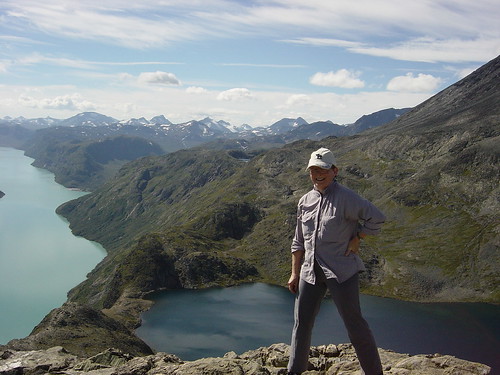
Quite honestly, I have been exhorting myself to exercise regularly since the age of 15 when my family doctor handed me the old XBX exercise paperback and said "Start here!". For no more than 14 days of my life have I exercised vigorously EVERY DAY- and that's when I have gone on holidays specifically to walk at least 10km/day over someone else's hills! I have plenty of photos to prove it, too!
Here I am at the famous Beseggen Ridge in Norway in mid 2004, a cardiovascular treat if ever there was one!


I see absolutely nothing in my neighbourhood, which is full of middle aged and older citizens, prominently encouraging us to come along to exercise sessions or enrol in a government-sponsored walking program. I have deliberately sought out suitable programs on the internet and discovered a Heart Foundation Walking Program, but I haven't managed to get along yet. There is also an early morning exercise class for "Seniors" at a local community centre, but it's at 7am and that is just dumb for most people who have blood pressure medication to take with breakfast!

At the other end of the spectrum, my neighbour has a 13 year old girl who rather fancies herself as Australia's answer to Paris Hilton (without the hotels, unfortunately), but I haven't seen her doing regular exercise around the neighbourhood, either. Isn't there a school health and fitness program to get these kids enjoying regular exercise as a normal part of their daily routine? Evidently not! This young lady HAS been attracted into a program where appearance is important- a cheerleading team- where some calisthenic moves are combined with a great deal of ribbon-waving and strutting around in glittery costumes! Are we missing something in the marketing department about what motivates regular exercise these days? Obviously, the promise of a glittery costume is not going to get me to the community centre at 7am any time soon, but I wonder what would?

I daresay I have quite a few risk factors for a stroke later in life:

1. I have had elevated blood pressure all my life, even during childhood.
2. Both my parents had high blood pressure- mum from her 50s, dad from his 70s.
3. I'm on some medication for another problem which actually CAUSES elevated blood pressure, but I have no alternative at the moment.
4. My mum started having mini-strokes/TIAs [transient ischaemic attacks] from her late 60s and died as the result of a stroke during an unrelated operation at 81.
5. I am rather physically inactive, though not as much as most people my age who I know.
6. Although currently at the upper limit of normal weight for my height, my weight is concentrated around my middle.
7. I weigh 157% of my weight on leaving highschool!

OK- I have a few helpful factors going for me- I've been prescribed (and take) a pill for hypertension and it works moderately, but not all the way back to "normal"; I haven't used sodium salt sprinkled on food for nearly 40 years- we used to have a container of 50/50 sodium/potassium salt for me to use on potatoes (the only thing I liked a bit of salt on), but it took 10 years to use it up!; I eat a diet which others would regard as fairly healthy and I rarely eat anything prepackaged like sweet biscuits, frozen meals; I have never had artificial sweeteners as I thought they might be bad for my liver- I had weird ideas that they must be taking up a metabolic pathway that should have been utilised by another foodstuff, goodness knows what- and I figured if I didn't like an unsweetened version of something I could just give it up!; my diet is almost vegetarian but I believe I need animal meat because I am an animal born to utilise eaten muscle to maintain my own muscle; my diet is also rich in raw fruit and vegetables containing lots of anti oxidants, plus I eat raw, fresh nuts of various sorts for lunch every day- also a 30-year habit. The only cheese in the house is low-fat and I drink plenty of water and black tea, rarely coffee or soft drink. Lastly, my father lived to the age of 95, despite having a congenital heart valve problem, which did lead to heart failure in the end- but you'd hardly say he had the usual kind of cardiovascular disease!

SO!!! What will persuade me and others like me to exercise regularly? I know that when I went to aquarobics twice a week with friends, it was the social contact and the regular expectation that got me there. Now I don't earn a living and don't qualify for government assistance, paying $40/week to attend is out of the question. However, this would be a good way to go for people with a normal income. I still like my idea of having community fitness trainers/leaders who are paid out of the national health budget to get people into regular exercise programs to the extent of thumping on the front door and yelling at them to come out!

The National Heart Foundation walking program for seniors should be what I attend, as it's free (mainly), but I haven't managed to get there despite several tries! I haven't seen the new video publicising the walks on TV, either- where is it?? Since it's about dog-walking, it's not really for me, but might encourage plenty of others.

I keep returning to the research on depressed young people, where researchers found that regular exercise was quite therapeutic and wonder how this sort of program could be financed and monitored locally. It could be quite attractive to public health campaigners as it literally kills two birds with one stone! There is plenty of good research on psychological health and exercise for older people as well, even for those who already have heart disease!

Goodness knows why I'm still here, sitting on my proverbial and not out there treating myself to a dose of free depression treatment while lengthening my expected life span!