Showing posts with label treatment. Show all posts

Thursday, May 17, 2012

Mental health for this one human

The Mental Health Blog Party almost escaped me as the past few days my mental health has taken a dip. I've been following my shrink's advice pretty well, except that the last two weeks I haven't had as much exercise each day and my flavoured fish oil supplement ran out.

She has been very thorough in getting my total physical health checked out with blood tests and ultrasounds for my suspiciously sore wrists. Now the arthritis has been diagnosed, I have mild pain control when I need it plus the fish oil and glucosamine supplements to attempt to hold deterioration back and even maybe regrow some joint covering. My slight thyroid deficiency has been dosed up, I don't have constantly cold hands and feet & I was at least more cheerful before I forgot the fish oil.

Therefore, today I drove into town and fetched my Melrose Lemon-Lime, de-odorised Fish Oil (as made for the Australian Rheumatology Association), guzzled a big 15ml dose and took myself somewhere in the sun. Off down to the beach I went to capture some warmth & sunlight before the black clouds roll in with forecast rain. Plus, I treated myself to a big fat boisonberry icecream cone! Let's hope I'm back on track in a day or two.

Classic madness= bedlam
There has been a little stigma attached to being depressed but more misconception, in that many people think that depression is ONLY a part of bipolar and they expect me to go all effusive & extravagant in between episodes. It's hard to explain the complexities of different mental disorders to ordinary people. To many people depression= MAD and Mad= totally out of control & round the twist!

It doesn't help the cause when the media dwell on poor souls like entertainer Matthew Newton, who has been out of control with his manic-depressive problems, ie. bipolar and in the headlines. There is a certain moral stance that people take when they hear that some violence has occurred during a manic episode such that they blame the person's character, rather than their inability to control their illness. Sure, if Matt Newton had murdered his girlfriends, he should be held partially responsible for his actions in not keeping his illness under control before it got to an extreme stage. However, loss of control involving some hitting or punching is hard to predict and is something a therapist and BP person need to work out. Good Control takes time, patience and a certain amount of luck.

The relative "fame" of Matt Newton's parents in Australia also makes people bitter towards him, saying things like "he's a spoilt child and should be punished for his crimes like anyone else". This is a man of 35 whose illness did not become fullblown or diagnosable until his late twenties, so his behaviour is hardly a result of childhood experiences. I would be happy to never hear anything more about the poor bloke or his confused parents (who are NOT young any more]. Maybe in a few years it would be good to see Matt settled in a quite niche writing scripts for TV or movies, but that's the limit. If he becomes more ill and needs further containment, I definitely don't want to know, but I hope his true friends stick with him, whatever.

For my own illness, maybe some stigma has been involved in my not being able to get a job for the past five years. I don't know. However, if I lose what little hope I have of being employed again and being able to secure some sort of a future, then my friends may never hear anything from me again, either. That's my life with a mental illness.
Mind Body Organisation is hosting this blog party, so give them a look too.


Content on this area requires a newer version of Adobe Flash Player.

Get Adobe Flash player


Saturday, August 7, 2010

Out damned paradigm!

I have decided that whatever double blind crossover placebo-controlled# trials can do for sorting out the good treatment from the bad, they're completely beyond the pale* in mental health!
My starting points are roughly these:
1. Taking major depression as an example:
a) every case has individual real-life occurrences as contributing factors: maybe being totally neglected emotionally as a child, or having a string of teenage relationships ending in "betrayal".
b) every case happens to a different brain

c) every case has a certain set of present/absent, good/bad liver enzymes
d) whatever the age, size or shape of the person, they have a different "felt response" to the same dose of a drug
e) everyone has different ways of reasoning
f) we all afford differential salience to "stimuli" such as words, happenings, situations and other people's moods.
g) if interpersonal therapy happens, each person will have a different first impression (therapist AND client), which will influence the course of the relationship;
h) therapists all have different interpretations and ways of implementing different therapies (their "style")
i)different client vs. therapist personality combinations either work or don't work in particular therapies, no matter what the therapist thinks about their own "objectivity" in the interaction.
j) clients have differing "stickability" in their regularity and timing of visits to a therapist.
k) additional contributors may/may not occur DURING treatment by any mode eg. parent dies, husband leaves etc.
l)many factors contribute to what "dose" of therapy or medication will alter core symptoms, regardless of liver enzymes etc.
m) many people on medication never get a good therapeutic effect because of recommended dosing levels, especially if they are not referred to a specialist after partial response. Specialists can observe the person while pushing the medication to the biological limit and achieve complete remission (or rule out that medication).
n) people have different "feeling criteria" of when they are "OK" again after an amount of treatment- it may be quite different to what a therapist concludes.

Anyway, having committed heresy, I'll slink away to gather some evidence!

Thursday, February 25, 2010

Gout- a very ouchy problem!

I hadn’t ever expected to blog about gout, but a few things have pushed it to the forefront of my attention lately.

One- I discovered that a friend my age has it quite badly and two: I didn’t realize this is just one of the many forms of arthritis (there are more than 100- yikes!)!

Having decided to inform myself, I found it was a timely topic- The Lancet has just had a leading article on it and most of it is pretty readable for an educated person, not just for medicos. Here’s a link to the Abstract, but you’ll have to use your connections in the business or a science library to read the whole caboodle:
Richette P and Bardin T (2010) Gout. Lancet. Jan 23;375(9711):318-28.

The docs have provided a beaut explanation of the current state of gout knowledge and how to treat it and relieve the symptoms. Sufferers are [rightly] much more vocal about the symptoms themselves- gout hurts to high heaven wherever you get it! [Insert loud groans and screams here]. It certainly laid low my friend on several recent occasions when he would far rather have been out enjoying himself. It also seems to make him and others quite depressed- which I guess can also be the result of taking a lot of pain killers.

All I knew before researching this topic was that some crystals accumulated in the joints somehow; that they were sharp, and that they maybe scratched the bones and thus hurt a lot! Apparently, that’s almost true, except for the fact that gout is really a form of arthritis, (meaning inflammation of joints: Greek ‘arthro’= joint and ‘itis’= inflammation), and that the crystals irritate the joint linings which makes them swell up and produce pain- it’s not the physical scratching from some great chunky quartz-type crystals, but tiny little pointy things in spaces they shouldn’t be. Here’s a pic from the internet:


Monosodium urate crystals


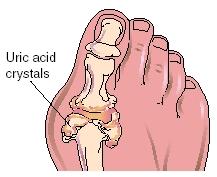
The traditional spot for gout to show up is in the big toe- here’s a diagram to show where the crystals deposit.

Now I know why I saw a lot of old guys with the toe cut out of their shoes when I was a little kid growing up in a country town! The pain is felt all over the toe and really gets bad if your shoe rubs the end of it.

Unfortunately, gout can cause arthritis in most joints- my friend has it in the knees, for instance. What can add to the pain and discomfort is the occurrence of swelling and heat around the joint such that ice packs are very welcome, as well as pain killers and anti-inflammatories (like aspirin).

I wondered where the crystals came from or why they accumulated in the joint spaces, rather than in the kidneys (like other crystals I’d heard about, eg. kidney “stones”). Well the uric acid crystals actually come from processing proteins we eat- I won’t explain the whole process as you can look it up. The folklore about gout being caused by a diet that is “too rich” and “having too much to drink” is not all true.

Most gout has some inherited component- it “runs in families” and researchers are identifying some possible target genes. It is a metabolic problem where the usual pathways though and out of the body for the urate crystals are disrupted or diverted. Instead of all the extra uric acid we don’t need getting ferried out through the kidneys, too much of it hangs around in the blood permanently. With ageing, the concentration is more difficult for the body to cope with and the crystals percolate out of the blood and into the tissues, accumulating in the joint spaces where they hurt. Also, if it isn't treated properly you could end up with permanently damaged joints and need joint replacements. Alternately, if you become dependent on steroids to control the symptoms, you get all sorts of nasty side effects which wreck other aspects of your health! Bad scene- better to change your diet!

Most of the foods that contain the protein that causes uric acid build-up are also nice tasty, popular foods like: red meat, shellfish, other popular fish, roe/caviar, asparagus, cauliflower, mushrooms, peas, beans and lentils; plus there is the traditional culprit alcohol.

So if you know someone with gout, don’t make fun of them, as gout is definitely NOT a fun thing! Be sympathetic when they have an attack and either help them out with rest and ice packs or leave them alone for a day or two to get over it. By all means encourage people to seek expert care, as there is a lot more treatment available these days than when those old men cut the toes out of their shoes!